Discourse and Truth and Parresia by Michel Foucault
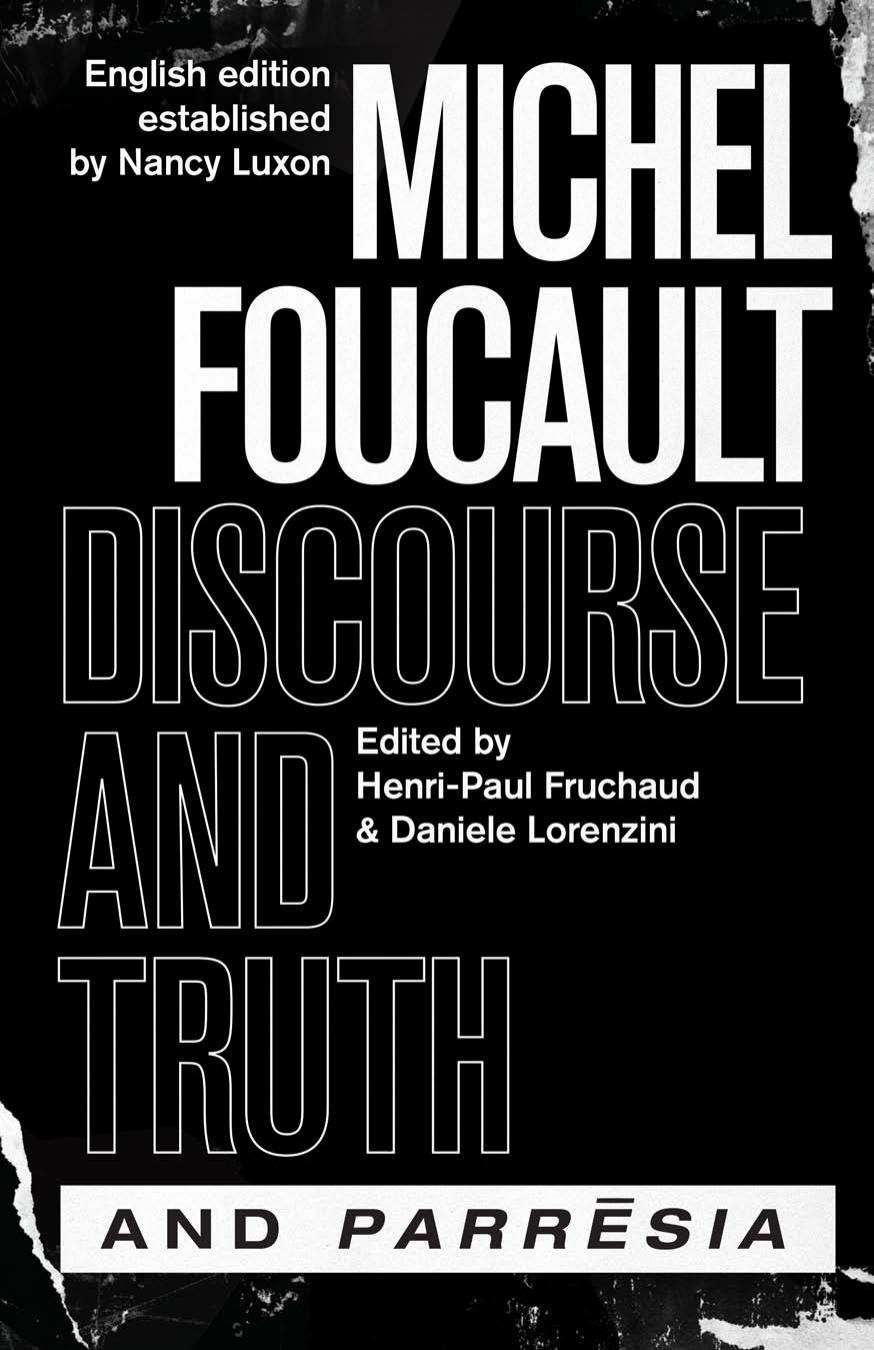
Author:Michel Foucault [Foucault, Michel]
Language: eng
Format: epub, pdf
Tags: philosophy, Political, social, political science, History & Theory
ISBN: 9780226509464
Google: MiWgDwAAQBAJ
Publisher: University of Chicago Press
Published: 2019-11-15T00:27:29.444551+00:00
November 21, 1983
You recall that the last time we met, and analyzed the text from the Laches, we saw the emergence with Socrates of a new type of parrÄsia, a type of parrÄsia that is, I think, very different from the political parrÄsia we have studied through Euripides and other texts. I think that this text from the Laches dramatizes very clearly a certain displacement in the parrhesiastic role. Remember that in the Laches we had a game with five people, or five partners. Two of them were very well born, wealthy citizens, but they were not able to use parrÄsia and to play the parrhesiastic role, and they did not know how to teach their own children. So they turned back to two other types of menâtwo famous citizens, a general and a political figure, one of whom was Laches and the other Niciasâand those two were also unable to play the parrhesiastic game, and they were obliged to turn to Socrates, who appears as the real parrhesiastic figure. You see through this case the move from political parrÄsia to philosophical [parrÄsia]. I also think that we saw at the very beginning of this dialogue a characterization of the parrhesiast; this characterization was determined not by birth and social status, but by a certain harmony, a certain relation between what the parrhesiast says and what he does, and the way he lives. And third, at the very end of the dialogue, we have seen just how far this parrhesiastic game was able to go. Of course, the parrhesiastic game played by Socrates did not define courage, but everybody agreed at the end of the dialogue that Socrates, in spite of the fact that he was unable to give a good, clear definition of courage, should help others to take care of themselves.
So I think that taking this text as a point of departure, we can observe through Greco-Roman culture the rise and the development of a new type of parrÄsia, a new kind of parrÄsia that we could characterize in the following way.
First, this parrÄsia can be characterized as a philosophical parrÄsia. I say that it is a philosophical parrÄsia because it has been put into practice during centuries and centuries by the philosophers, and also because a large part of philosophical activity in Greco-Roman culture has been devoted to the parrhesiastic game. Very schematically, I think that we could say that the philosophical role entailed in Greco-Roman culture three different kinds of games, each related to one another. [It has an] epistemic game or role, insofar as philosophy has to discover and to teach some truth about the world and about nature. The philosophical role entails also the political game, insofar as the philosopher has to take a position towards the city, towards nomos, towards the institutions, and so on. There is also a parrhesiastic game in the philosophical activity in the Greco-Roman culture from the fourth century until early Christianity. This third role is a parrhesiastic activity
Download
Discourse and Truth and Parresia by Michel Foucault.pdf
This site does not store any files on its server. We only index and link to content provided by other sites. Please contact the content providers to delete copyright contents if any and email us, we'll remove relevant links or contents immediately.
| Anthropology | Archaeology |
| Philosophy | Politics & Government |
| Social Sciences | Sociology |
| Women's Studies |
Born to Run: by Christopher McDougall(7117)
The Leavers by Lisa Ko(6942)
iGen by Jean M. Twenge(5403)
Sapiens by Yuval Noah Harari(5360)
Spare by Prince Harry The Duke of Sussex(5173)
The Kite Runner by Khaled Hosseini(5159)
Machine Learning at Scale with H2O by Gregory Keys | David Whiting(4289)
Bullshit Jobs by David Graeber(4176)
Never by Ken Follett(3929)
Goodbye Paradise(3795)
Livewired by David Eagleman(3759)
Fairy Tale by Stephen King(3365)
A Dictionary of Sociology by Unknown(3065)
Harry Potter 4 - Harry Potter and The Goblet of Fire by J.K.Rowling(3054)
The Social Psychology of Inequality by Unknown(3013)
The Club by A.L. Brooks(2917)
Will by Will Smith(2899)
0041152001443424520 .pdf by Unknown(2842)
People of the Earth: An Introduction to World Prehistory by Dr. Brian Fagan & Nadia Durrani(2723)
